
Disclaimer: The information provided in this blog is for general informational purposes only and does not constitute legal, tax, or accounting advice. Nothing on this site should be relied upon as a substitute for professional advice from a licensed attorney, CPA, or financial advisor. Please consult a qualified professional before making any financial or legal decisions.
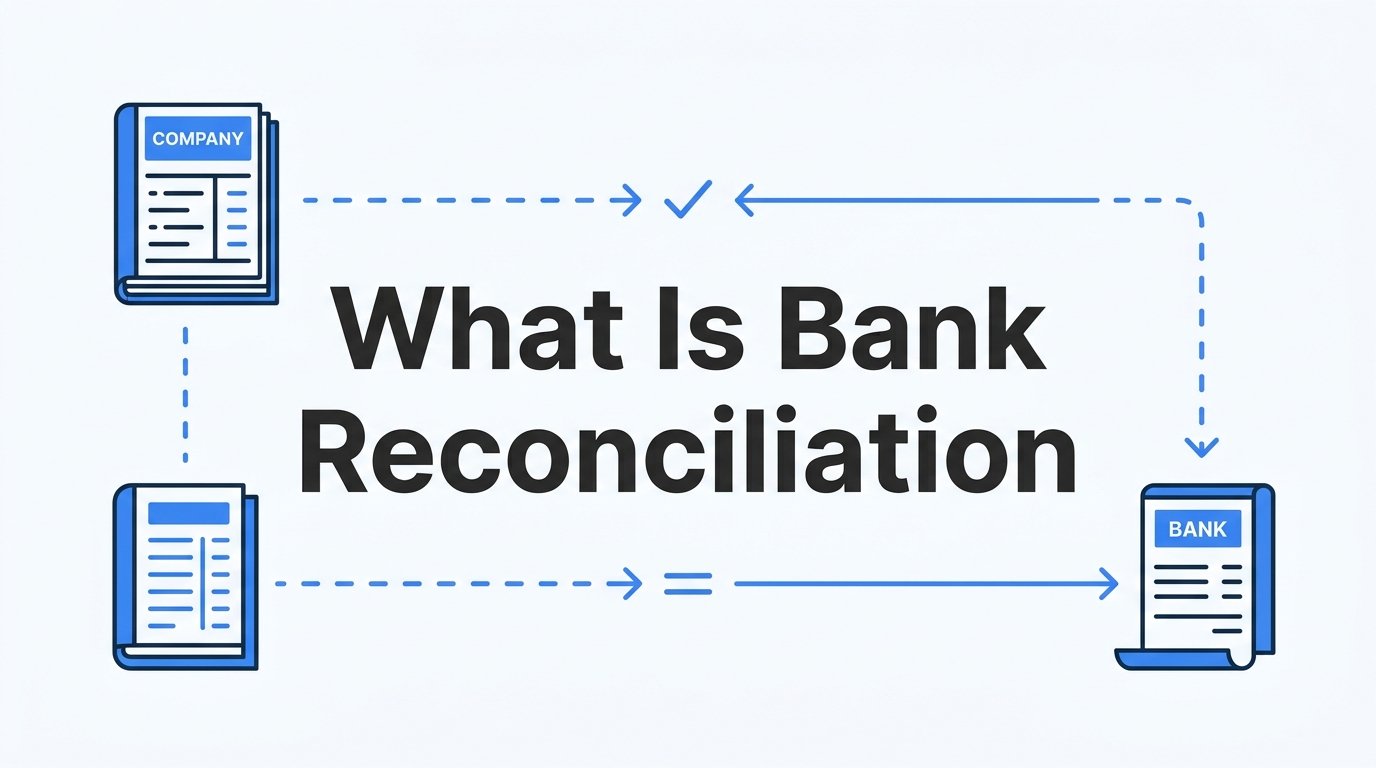
Bank reconciliation is the process of matching your company's books to your bank statement to confirm that both agree. When they don't, the process explains every difference, and most of the time the cause is timing rather than a mistake.
If you have ever wondered what bank reconciliation is and whether a small business really needs it, the short answer is yes. It takes a few minutes of structured comparison and tells you whether the cash number you rely on is real. The sections below cover why it matters, why the two balances differ, the step-by-step process, a worked example with numbers, and the mistakes to avoid and how often to do it.
Why Your Books and Your Bank Rarely Match
Two records are being compared. The book balance is the ending balance of the cash account in your general ledger, the master record of every transaction your business has recorded. The bank balance is the ending balance on the statement your bank issues. Neither is wrong by default. They simply capture the same money at different moments and through different information.
Timing differences
Most gaps come from timing. An outstanding check is one you wrote and recorded in your books but that the payee has not yet cashed, so the bank still shows the money in your account. A deposit in transit is money you recorded as deposited, often late on the last day of the month, that the bank has not yet credited. Both clear on their own in a following period, and neither requires a correction to your books.
Items the bank knows first
Some transactions hit the bank before you record them. Common examples:
- Monthly service fees and other bank charges
- Interest earned on the account
- An NSF check (non-sufficient funds), meaning a customer's check that bounced and was returned to you
- Automatic debits, such as loan payments or subscriptions
- Direct deposits from customers that you have not yet entered
These do require action. Your books are missing them, so you record them.
True errors
Occasionally the difference is a real mistake: transposed digits (recording $540 as $450), a payment entered twice, or a check recorded for the wrong amount. Banks make errors too, though rarely. Reconciliation is how you find either kind, and it is why a mismatch should prompt investigation rather than panic.
What Reconciliation Protects You From
The bank statement is an independent record of what actually left and entered your account. Your own books reflect what you and your staff entered. Comparing the two is one of the simplest controls a small business has, because anything unauthorized, such as a payment you never approved or a withdrawal you don't recognize, shows up as an item on the statement with no match in your books.
Fraud detection is only one benefit. Reconciliation also keeps the cash figure accurate, and that figure feeds your financial statements, your tax preparation, and everyday decisions like whether you can cover payroll or pay a vendor this week. A cash balance that is off by a few hundred dollars can quietly lead to an overdraft.
It also surfaces smaller leaks before they compound:
- Duplicate payments to a vendor, which appear as two identical debits
- Missed bills, where an automatic charge you forgot about has been pulling money for months
- Bank fees that creep up after a change in your account terms or balance requirements
If you want data on how occupational fraud is typically detected and what it costs, the Association of Certified Fraud Examiners publishes its Report to the Nations periodically. Check the latest edition directly rather than relying on secondhand figures.
The Bank Reconciliation Process, Step by Step
The mechanics are the same whether you use a spreadsheet, paper, or accounting software.
- Gather your documents. You need the bank statement, the general ledger cash account for the same period, and last month's completed reconciliation.
- Confirm the beginning balances. This month's starting balances should equal the ending figures from the prior reconciliation. If they don't, something in the prior period was changed or entered after the fact, and you should sort that out first.
- Compare transactions. Go line by line, ticking off each item that appears in both records. What remains unticked on the bank side and on the book side are your reconciling items. Write them down in two lists.
- Adjust the bank balance. Start with the statement's ending balance, add deposits in transit, and subtract outstanding checks. The result is the adjusted bank balance, which is what the bank balance will be once timing items clear. If you find a bank error, adjust for that here as well, and contact the bank.
- Adjust the book balance. Start with the ledger's ending balance, subtract fees, NSF checks, and automatic debits you hadn't recorded, and add interest and unrecorded deposits. Correct any errors in your own entries. The result is the adjusted book balance.
- Check that they agree. The adjusted bank balance and adjusted book balance must be identical. If they are not, recheck your math, look for a transposition, and compare any difference against individual transaction amounts. A gap of exactly half the difference can signal an item entered on the wrong side.
- Record and file. Post journal entries for every book-side adjustment. Then sign and date the reconciliation and file it with the statement so the next period has a clean starting point.
Only the book-side adjustments change your ledger. The bank-side items, deposits in transit and outstanding checks, simply wait to clear.
A Worked Example With Numbers
The following is a hypothetical illustration, not data from a real business. Suppose your bank statement shows an ending balance of $12,400, and your ledger shows $13,080.
Adjusting the bank side
- Bank statement ending balance: $12,400
- Add deposit in transit: +$1,500
- Subtract outstanding checks: -$900
- Adjusted bank balance: $13,000
Adjusting the book side
- Ledger (book) balance: $13,080
- Subtract bank service fee: -$30
- Subtract NSF customer check: -$50
- Adjusted book balance: $13,000
Both sides arrive at $13,000, so the account is reconciled. The $80 difference between the original balances was explained by the fee and the bounced check, while the deposit and the checks were only timing.
The journal entries
Two entries are needed, one for each book-side item:
- Bank fee: debit Bank Fees expense $30, credit Cash $30.
- NSF check: debit Accounts Receivable $50, credit Cash $50. This puts the customer's debt back on your books, since they still owe you the money, and gives you a reason to follow up.
No entries are made for the $1,500 deposit in transit or the $900 in outstanding checks. They are already in your books, and the bank will catch up when they clear. If either is still outstanding next month, it carries forward on the next reconciliation.
Common Reconciliation Mistakes and How Often to Do It
Mistakes that undermine the result
- Forcing the balance with a plug entry. Booking an unexplained "adjustment" to make the numbers agree hides the problem you were supposed to find.
- Skipping months. Unreconciled periods pile up, and errors become harder to trace the longer they sit.
- Using the wrong statement period. Matching a March ledger to a statement that ends mid-month produces differences that aren't real.
- Letting one person do everything. If the same person who handles cash, writes checks, and records transactions also reconciles the account, nobody independent is checking their work. This is a segregation of duties problem. In a small team, even having the owner review and sign the reconciliation helps.
How often to reconcile
Monthly is the minimum, as soon as the statement arrives. Businesses with many transactions often reconcile weekly or even daily using bank feeds, which pull transactions into accounting software automatically.
As of 2026, many accounting platforms can import bank transactions and suggest matches. That saves time, but it does not replace review. Someone still has to confirm the matches are correct and investigate exceptions, because software can match the wrong items or miss a duplicate. Features and limits vary by product and plan, so check what your own software offers.
Beyond the checking account
Reconciliation is not only for large companies or only for the main checking account. Credit card accounts, payroll accounts, savings, and merchant processing accounts should be reconciled to their statements as well.
When to get help
Consider a bookkeeper or CPA if you have months of backlog, differences you cannot explain, or any suspicion of fraud. Cleaning up a backlog is routine work for a professional, and it is usually cheaper to do early than after a problem has grown.
Make This Week the Week You Reconcile
Reconciliation is a routine check that your books reflect reality. Pull your most recent bank statement, follow the steps above, and see whether your numbers agree. If you are several months behind or can't explain a difference, bring in a qualified bookkeeper or CPA rather than guessing. Numbers Southwest Inc is one resource you can reach out to.
Schedule a call and discover how we can help your business grow.